For a contract-services company with hundreds of staff, the risk is rarely a missing certificate. It is a valid one that quietly expired.
Ask a contract-services operator what keeps them awake and they rarely say "we do not know who is certified". They say "I do not know whose certificate runs out next month". The information exists. It is in a folder, a spreadsheet, and the memory of one supervisor who is on leave.
We built a business management system for a company with more than three hundred staff across many sites. The useful insight came early: almost every compliance problem in that business is a date that nobody was watching.
The common design is a staff profile with a checklist of documents. It answers "does this person have X?" — a question nobody is actually asking. The question is "who will stop being eligible, and when, and which sites does that affect?"
So the unit of data is not the document. It is the validity window: this person holds this qualification, from this date, until this one. Everything useful follows from storing it that way:
Attendance in this kind of business is usually framed as checking up on people. In practice its job is to answer an invoicing question and a dispute question: who was on this site, on these days, for how long — and can we show it when a client challenges a line on the invoice?
Designed as evidence, attendance needs to be simple to capture, hard to fake and easy to export in a form a client will accept. Designed as surveillance, it grows features nobody uses and everybody resents.
The feature that changed the most for this customer was not compliance tracking. It was a calculator that prices a new contract from real cost data — staff rates, site hours, consumables, margin — instead of from memory and an old spreadsheet.
Two things made it work:
Staff, sites, attendance, invoicing and bidding were five separate habits in this business before the system existed. The temptation when building is to deliver five good modules. The thing that actually determines adoption is whether the supervisor can do their whole morning in one place. A module that forces someone back into a spreadsheet for one step loses to the spreadsheet entirely.
SATUMM's Business Management system was built for WY Global (KL) Sdn Bhd in Malaysia, a contract-services company with 300+ staff.
 Artificial Intelligence
Translation was the easy part. The hard part was everything a language touches that is not text.
 Quality Assurance
Self-healing automation is sold as a fix for flaky suites. Used carelessly, it hides exactly the failures you built the suite to catch.
 Artificial Intelligence
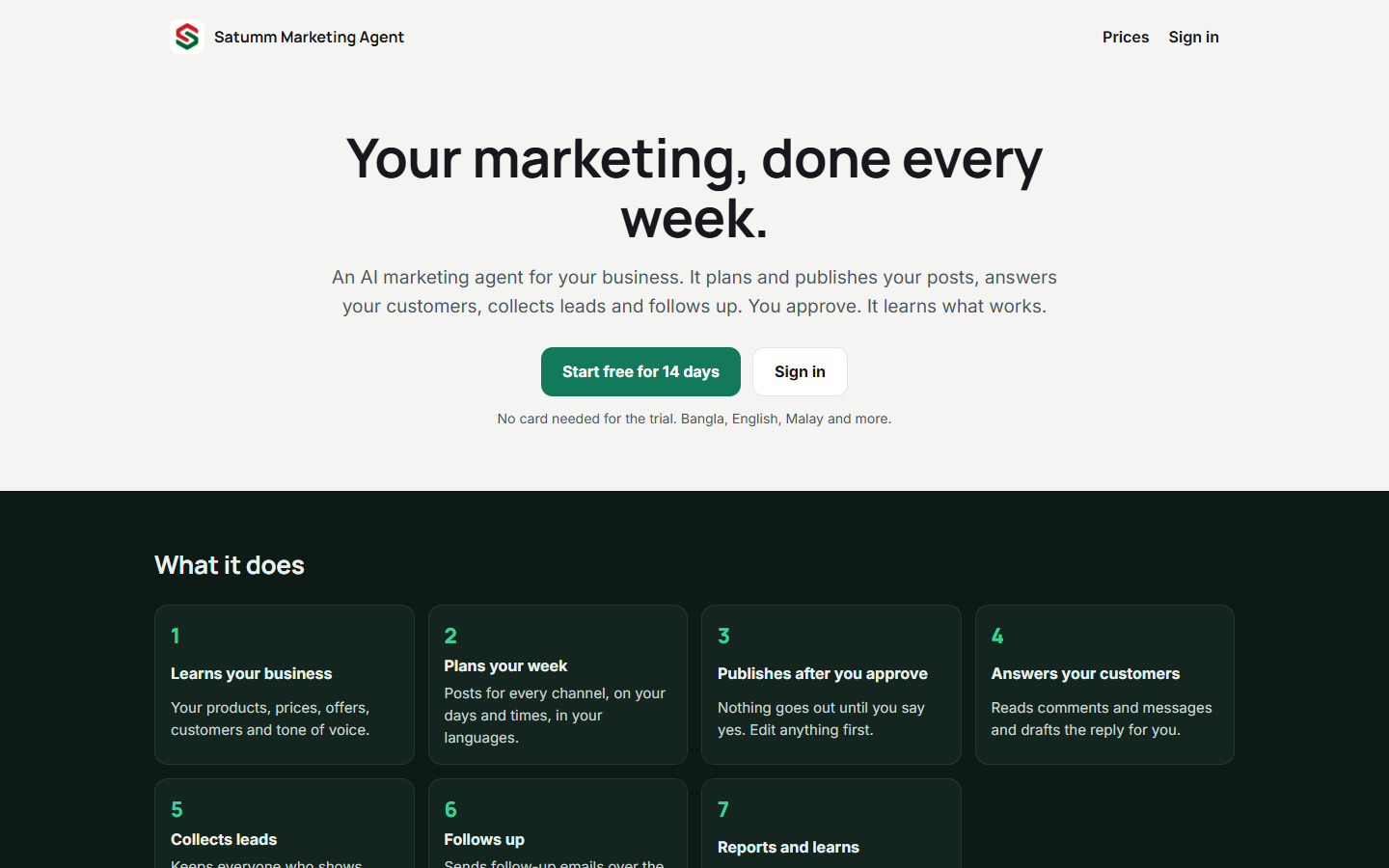
An AI that can publish is an AI that can publish a mistake under your name. Approval is not a setting — it is the architecture.
If it is, we would rather talk it through than have you read another article about it.
